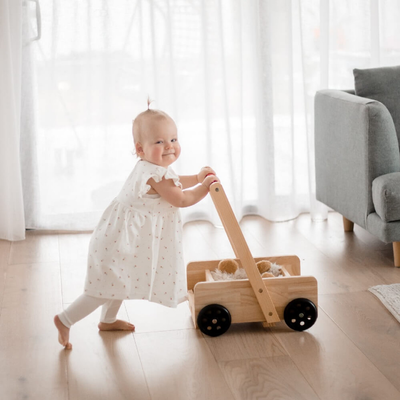
For many years, parents have
favored baby walkers as a means of providing their young children with both
entertainment and movement. These movable toys help newborns move around, but
they also have several other effects on their general development. The benefits
of using baby walkers for development will be discussed in this blog, with
particular attention to the development of motor skills, entertainment, and
cognitive development.
Also Read: Rediscover The
Beauty of Wooden Toys
Let's Talk About The Amazing Benefits Of Using Baby Walkers
Motor Skills Development
The capacity of baby walkers to
improve a child's development of motor skills is one of their main benefits.
Babies practice exercises that improve their leg strength, balance, and
coordination while they learn how to manoeuvre the walker. This is an important
physical interaction for various reasons:
- Leg Strengthening: Children who use baby walkers are encouraged to
propel themselves forward, which develops their leg muscles. Pushing off the
ground repeatedly helps to develop muscular tone and endurance, preparing them
for the eventual challenge of walking independently.
- Balance and Coordination: Using a wooden baby walker or other types of walker demands a lot of
balance and coordination. Babies' general balance is improved as they learn to
synchronize the movements of their legs with the walker. Their ability to
coordinate is a crucial component of developing motor skills, which will help
them when they get older and start doing more difficult physical tasks.
- Fine Motor Skills: Interactive toys and activities that demand
babies to use their hands are a common feature of walkers for kids. Fine motor
skills are necessary for daily tasks like writing and buttoning clothes, and
they can be developed through manipulating these toys.
Entertainment and Stimulation
The stimulation and amusement
that baby walkers offer is yet another important advantage. Babies like
investigating their surroundings because they are inherently interested. They
can satiate their curiosity in a safe and controlled manner with the help of a
baby walker.
- Interactivity: A wide range of interactive toys and features are
included in most contemporary baby walkers. Buttons, levers, and other moving
components that emit lights or sounds are frequently seen in these toys. A baby
can stay interested in this sensory stimulation for long periods, which serves
as entertainment and a kind of cognitive stimulation.
- Understand the Environment: Using a baby walker enables infants to
investigate their environment in a manner that is not possible when they crawl
or are carried. For a youngster, having the freedom to roam around may be
fascinating and enriching, providing them with a sense of confidence and
independence as they explore new areas of their house.
- Preventing Boredom: A baby walker's assortment of activities can
aid in preventing boredom. Parents will especially benefit from this since a
happy, involved infant is less likely to be cranky or demanding.
Promoting Social Interaction
Even though baby walkers are
frequently associated with isolation, they can also promote social contact.
Babies that are mobile have more chances to interact with family members and
even pets, which promotes social development.
- Family bonding: Babies are more likely to come into contact with
other family members as they wander around the house. As parents and siblings
play with the baby, bond over the joy, or just talk, these interactions can
result in special moments.
- Result-oriented Learning: Babies pick up a lot of knowledge from
the observation of others. They can follow family members about and observe
their activities because they are on a walker. Babies learn through
observation, which is an important part of social development because it
enables them to comprehend social cues, behaviours, and communication.

- Interaction with Peers: Walkers can help promote interaction
amongst peers in situations where there are several babies present, such as
playdates or childcare centres. Infants can watch and imitate one another's
behaviour, which paves the way for early social play and teamwork.
Promote Cognitive Growth
Additionally, baby walkers
contribute to the development of cognitive abilities in children. Babies engage
in activities that boost brain development as they interact with the numerous
elements of a walker.
- Problem-Solving Ability: Using a baby walker requires some
problem-solving ability. Infants must learn how to steer the walker in the
desired direction and how to avoid obstructions. This method of tackling
problems is very beneficial for developing critical thinking abilities and
cognitive growth.
- Cause and Effect: A baby walker's interactive features help infants
learn about cause and effect. For example, pushing a button might make a light
flash or play a sound. Comprehending the connection between acts and results is
a fundamental cognitive ability.
Baby walkers aid in the
development of spatial awareness in infants. They start to grasp ideas like
direction, distance, and the relationships between items in their surroundings.
Both today and in the future, this awareness will be essential for jobs
involving navigation and direction.
Also Read: Best First
Birthday Gift Ideas to Buy For Babies in Australia
Looking To Purchase Baby Walkers in Australia? Buy From Us and Get
Fast Shipping!
In addition to being convenient
for parents, baby walkers can assist and stabilize a child's development of
motor skills, improve cognitive function, encourage independence and
self-assurance, and foster independence. However, as with other baby devices,
it's important to put safety first and make sure that the child is properly
supervised.
Being
a leading kids' online toy store in Australia,
our beautiful and sturdier wooden baby walkers come in different colours and
designs that would let your little one enjoy its company. All our products are
sustainable and meet superior standards of quality. They are just perfect for early childhood
learning, exploration and development. To know more, contact us today.
FAQs
Does a baby walker help my child
learn to walk?
Baby walkers create a
fun way for your baby to stay upstanding and discover the nearby space, but
it's necessary to also promote independent walking.
How long can my baby use a walker each day?
To avoid becoming overly
dependent on walkers, it is advised to keep walking sessions to no more than 15
to 20 minutes.
When my baby uses a walker, what safety measures should I take?
Limit the amount of time your
child spends in the walker, keep an eye on them at all times, and make sure the
environment is risk-free.